Wednesday, April 18, 2018

Expert Witness in Trial of Four LAPD Officers Still Testifies Today

In The Possessive Investment In Whiteness, George Lipsitz explains how the “the language of liberal individualism” is used to obscure “systemic, collective, and coordinated behavior” (40) which perpetuates racial injustice in the modern world through its focus on individual action and (mis)behavior. Relics of this larger, hidden, systematic behavior which lead to the beating of Rodney King and the acquittal of the four policemen who beat him persist to this day. Greg Meyer is a “use of force expert” who testified during the Rodney King trial, and according to his website he “has been engaged in more than 200 cases involving shootings, TASERs, arrest-related deaths, and other police procedure matters”.
Meyer still serves as an expert witness today, being paid to testify “for the defense of officers and agencies” (aele.org). He recently testified in a case involving a man shot by the police, and speaking from his position of expertise, Meyer claimed that the officers were not at fault, were simply following policy, did not use excessive force, and that the policy (not the officers’ individual action) is to blame. If you research Meyer on the internet, you can find various news article of him testifying in defense of policemen who were accused of using excessive force on civilians. The fact that Meyer today earns a wage spouting the same opinion which lead to the acquittal of the four LAPD officers in the King case is representative of the fact that these larger, bureaucratic forms of oppression have a legacy which has endured since 1992 and continue to lead to the acquittal of police officers who engage in acts of violence.

- John Campos


Lynching With Another Name


When thinking of what led up to the 1992 race riots most would initially think of Rodney King and the four police officers that were acquitted for beating him profusely. This event, although was a key piece in the ignition of the riots was not a surprise or a sudden revelation of police brutality or racism. The Rodney King beating, due to George Holliday recording it, was different due to its prevalence in the media. But racism is not something that was new during the 90s nor is it something that has disappeared in the present. 

Jim Crow laws, lynching, slavery: they were all atrocities that prefaced the LA riots. Things didn't just explode when the verdict of the police officers was released. There was always much more that was lying beneath that led to the riots. Lynching is seen throughout history. The lynching of the black man is now in other words the police brutality inflicted on the black man. Lynchings were family events where people would go out and have roasts. Parents would bring their children and hoist them on their shoulders to get a better look at what was going on. People would buy postcards of lynching images and even buy audio recordings of the screams of the people being lynched.

Lynching is still seen in present day and that is through the deaths of people like Butchie Yarber. He was shot 30 times in a Walmart parking lot. Butchie Yarber was unarmed. In an article in The New Yorker Carvel Wallace states, “How would it be possible to get along in a city where the police operate above the law, where African-Americans suffer daily under the lash of a crooked justice system that echoes the brutality of slave catchers and overseers?” Lynching is echoed throughout history into present day, it only evolved and has a different name. 

By: Victoria R.


Past and Present: A Lack of Educational Opportunities

Past:

The East Los Angeles Walkouts or Chicano Blowouts of 1968 were a pivotal moment in time for Chicanos. Thousands of students in the Los Angeles area walked out of their high schools. These walkouts were done in protest of the poor educational opportunities that were being offered to Chicano students. The unequal conditions in LAUSD high schools led to a high percentage of dropouts. Students had become fed up with the quality of their education they decided to take matters into their hands and were able to meet with the board of education in order to enact the students' demands. This lack of education or poor quality of education was not affecting schools in predominately white areas. Chicano students formed coalitions in order to help each other achieve a greater education. Students met with the board of education; in this meeting, students came up with a list of demands which they felt were the most important issues that affected their education.


Present:

The 1992 LA riots signified a change, they demonstrated the frustration that many felt. Frustrated due to the fact that they were being mistreated and ignored. There were numerous injustices that preceded the 1992 LA riots and there has been little effort made to change these injustices. To this day there are many schools in East Los Angeles that still do not have the educational opportunities that schools in predominantly white areas have. Many Latino students continue to fight for justice and equality within the educational system.


--Aurosal Ayuso

Bloody Sunday vs. LA Riots

The LA riots of 1992 and the first Selma to Montgomery march on March 7, 1965 are united by the reasoning behind why they were created, however, the mode in which they were executed could not be more different. This Selma to Montgomery march was a nonviolent, peaceful walk put together by the DCVL, SNCC, and SCLC that was met with extreme violence from state and local police and resulted in 17 marchers being hospitalized and 50 being treated for lesser injuries. This violence gave it its name "Bloody Sunday". The march across the Edmund Pettus Bridge became a televised event that shocked the nation. The marches were sparked by the death of Jimmie Lee Jackson who was a black civil rights activist who was killed during a nonviolent protest for James Orange's detention, who they fear would get lynched. Jackson was brutally killed by a white police officer when he attempted to protect his mother from being beaten because the officer thought he was trying to reach for his gun. These marches were also held in order to advocate for African-American's constitutional right to register to vote which was being repressed by segregationists and it was a key event that led to the passing of the Voting Rights Act of 1965.


The LA riots were brought about by the excessive force used on Rodney King, an African-American male, when he was being pulled over by police for speeding and refusal to pull over. The four policemen who assaulted him used their batons to keep him on the ground instead of cuffing him and continue arresting him. This event was so significant because it was caught on tape by George Holliday and given to a news outlet which then spread rapidly causing the video to be known internationally. King's beating was the last straw for the Los Angeles community, they were tired of the unnecessary treatment to minorities by law enforcement so they took action through violence and destruction. This led to 63 deaths, 2,383 injuries, and 12,111 arrests and a retrial of the officers involved which found two of the four guilty.


Although the marches and the riot were fighting for similar causes and both were televised, the way in which they tried to act on their issues were polar opposites. They both reacted to injustices that needed to be rectified and both received results. It may be argued, however, that the nonviolent movement may have caused a larger and more noticeable change in the country while the violent movement got a retrial and little change to police itself. The LAPD, as well as most other police departments, changed for the better over time, but no direct changes came directly from the riots. The Voting Rights Act of 1965 was not passed simply because of the marches, but it had a major influence on the public pressure for it while attempting to cause as little unrest and destruction as possible. The cost (deaths, injuries, destruction of property etc.) versus results (changes in society or government) for the peaceful movements far outweigh that for the violent ones.

Jamie Livengood

Racism in The Legal Process


In the court case heard in front of an all white, affluent jury in Simi Valley, there was no justice for Rodney King, and there was absolutely no representation for him. There was only a group of people who could not understand the opposing point of view, and who respected the position of police officer and the white color of their skin, leading to an acquittal. This, of course, has been a problem with our legal system since the beginning of time. Once specific Case I would like to point to is called the Sleepy Lagoon Trial that occurred in 1942. On the night of August 1st, the 38th Street Gang had some altercations with an opposing gang at a reservoir known as the "Sleepy Lagoon". The next morning, the body of Jose Diaz was found , so they naturally took in about 600 Mexican American youths in for questioning, only because the 38th Street Gang was identified in the area. With no other evidence and only a whole lot of prejudice, the case went to court. The bias and hatred that the whole courtroom had against these young Mexican American boys and girls made it nearly impossible to present their case and receive an acquittal. This bias and racism extended outside of the courtroom, with the press pushing their racist views and biased opinions on the general public, making it so that a fair trial was completely impossible to achieve. It's infuriating to recognize this since the whole purpose of our legal process is to give all people a fair and equal trial, and to enter a courtroom "innocent until proven guilty". Not a single person who entered the courtroom during the Sleepy Lagoon Trial was presumed innocent, and there was no way to sway the judge or jury in the opposite direction. Just as the officers in the Rodney King case were never going to get convicted, these kids were never going to get acquitted. In both circumstances, the court case was a formality in order to attempt to explain and justify blatant racism.
  In present day, this discrimination and racism in the legal system is still very much apparent, and rears its ugly head in most trials which involve black people, specifically when compared to cases almost identical in facts, but with a white person going to trial instead. The modern day case that I will be focusing on is the case of Andre Thomas. Andre Thomas is a mentally ill black man who murdered his white wife and children. For this crime he was sentenced to death and is on Death Row. The prejudice and racism enters this case when we examine how he was portrayed throughout his life, prior to this horrific incident. Thomas would never have received a fair trial because in court he was painted a criminal in every sense of the word, with a long history of violence and hatred, and who doesn't deserve to be alive. However, if Thomas were white, the story that would have been told would include his mental illness, and how he killed his children in the hopes of freeing them from a demon he believed to live within them. It would also be described how he grew up in poverty, overcoming obstacle after obstacle and bringing joy and happiness to so many over the years. The true racism in the legal process lies in the story that is told about them and the implicit bias that each juror has entering the case.
-Sasha Monterroso

Past and Present: Ongoing Cycles of History

Past:
Although the complete history of racial animosity in the United States and the west in general is definitely beyond the scope of this post, one of the earliest precursors to the LA riots of 1992 could be the Haitian revolution of 1791. While on the surface these events may seem somewhat disconnected, in reality, the Haitian revolution arguably set the precedent for the countless racial revolts in centuries to come.
From around the 14th century, Haiti and a number of other caribbean countries were held as colonies by european countries (initially spanish rule and eventually french ). In Haiti specifically the social and regional stratification led to extreme racial tensions. There were roughly ten times as many people of color as whites. Eventually in 1791, self emancipated slaves led a successful anti-imperialist uprising against french colonial rule. The uprising was incredibly violent. Nearly 162,000 people died. However, following the expulsion of the french and the rise of people of color, Haiti was established as a sovereign nation and one of the first democratic states. While the Haitian revolution did take place over 200 years before the LA riots, both of these events connect to a larger historical thread of mass racial uprisings and rioting in america and around the world in response to white racist and imperialist rule/control.


Present:
Unfortunately, many of the issues that led to the LA riots of 1992 and riots of the past persist today. Economic disparities, Police violence, the prison industrial complex, all continue impact individuals and communities of color. Most recently, the deaths of Oscar Grant, Mike Brown, Trayvon martin, Sandra Bland, Philando Castille, Stephon Clark, and many others at the hands of the police officers and self affirmed vigilantes across the country have inspired numerous protests and uprisings. Organizations such as Black Lives Matter have led demonstrations in Ferguson, Charlottesville, Oakland, Baton Rouge and around the country over the past few years in response to these shootings as well as white supremacist and neo-nazi rallies.
Nonetheless, black and brown people continue to be controlled and “disappeared” by larger social, political and primarily economic structures such as the prison industrial complex and the school to prison pipeline. In fact, despite making up only 13% of the U.S. population, black people account for 40% of the U.S. prison population. Much like in the past, black people continue to be dismissed by society at large and relegated a sort second class citizenship. As a result of this racially biased targeting, black and brown people who are incarcerated are often unable to vote, obtain affordable housing, get a job, so on and so forth. Even centuries later, these complex cycles of inequality and oppression continue to repeat themselves.


-Davis O’Shea

The Race Riot in American History

Martin Luther King once described riots as "the language of the unheard." Leading up to what we now understand as "race riots" of people of color in Watts, Newark, and Detroit, and, later on, Los Angeles, there were the "race riots" led by white mobs from the Civil War into the Jim Crow era. These riots were a hateful predecessor to the events of 1992, the events of which would be considered to merely be a tipping point. They would often make spectacles of publicly hanging black folks and burning their houses. Some uprisings of note include the New York City draft riots where Irish-Americans led the largest racially charged insurrection in American History by working class white rioters against blacks being drafted for the Civil War, the death toll at 119 or 120 individuals. The conditions were so bad, martial law was considered, however a satisfactory amount of military force was unavailable due to the Civil War itself. Others include the fall of a self-sufficient African American community in Tulsa, Oklahoma called "Black Wall Street" in 1921, where white neighbors destroyed property and, for the first time, the US Government bombed an American community with airstrikes. In 1947, whites in South-Side of Chicago neighborhood Fernwood Park rioted over several African-American veterans and their families moving into a local housing project. The violent mob lasted for three days and required 1000 law enforcement officers to extinguish, although doing little to stop the rioting as evident in the Airport Homes riots which also happened in Chicago in West Lawn and West Elsdon only a year before, started by women and the elderly, also over the objection towards black veterans and their families moving into their communities.

Almost a century after so-called "race riots" by whites and a mere 25 years after the uprising of 1992, although there was only one casualty, there was what many consider to be a riot in Charlottesville, Virginia on August 11 and 12 of 2017. The Unite the Right rally, which was a later on known to be the Charlottesville riots, started out as a rally in protest of the removal of a statue of Confederate General Robert E. Lee from Emancipation Park and grew into a state of emergency declared by Virginia governor Terry McAuliffe. Protesters included white nationalists, Klansmen, and neo Nazis who collectively chanted racist, antisemitic, and homophobic slogans while carrying semi-automatic rifles, swastikas, Confederate flags, and banners containing hate messages. This took place when the night before, a march of white nationalists marched through the University of Virginia campus bearing Tiki torches and chanting slogans including "White lives matter" and "Jews will not replace us". The protest took a violent turn when members of the rally clashed with counter-protesters, leaving over 30 injured, reaching its peak when a car with white-supremacist ties rammed through a crowd of counter-protesters, injuring 19 and killing one. Tension arose when President Trump failed to condemn white nationalist explicitly by instead stating there was "hatred, bigotry, and violence on many sides." In their own narrative, the events Charlottesville may have been a tipping point for white-supremacy.


Jose Domingo

How Police are still causing racial outrage

    You know, one would think that after a few couple of times, the government and law enforcement would wise up when dealing with death caused by the police. It seems like the killings of African-Americans by the police haven't stopped, even after one death caused the whole city of L.A. to go into a riot. Heck, even Anna Deavere Smith called the riots "A war between residents and police officers" (Smith, page xix). It's surprising that more riots still happened after that, like with the Charlottesville riots a few years back. Police brutality hasn't changed a bit, and that's frustrating.

It only seems to get worse, looking back on the recent and not-so-recent killings of African-Americans. The first major one was Rodney King, who was beaten to death for simply speeding; then you look to the more recent ones, with black men and even children being shot because they looked "suspicious", when they in fact did nothing wrong. And some of the law enforcement have gotten away with it, like the man who shot Trayvon Martin got acquitted because of claims of "self-defense". It's terrible really, which is why it is most important that we take a look back on how these acts started, how they have adapted to today, and what we as human beings can do to stop it.

                       John Cuneo

Bloods and Crips: Devaluing Strangers and a Musical Alternative to Bangin'

https://www.youtube.com/Bloods-and-Crips-G'z-and-Locc's


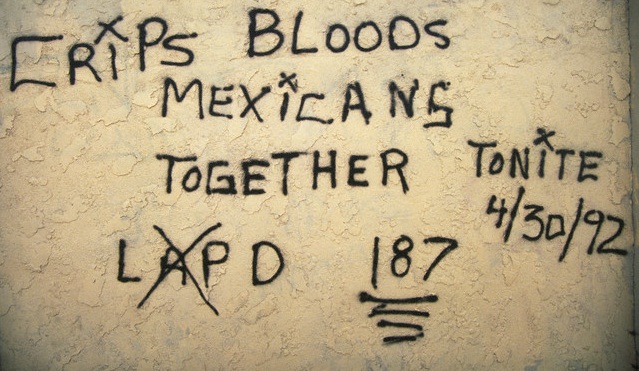
           Above is the link to a song from the experimental record label, Bangin' on Wax, which was the first album where Crips and Bloods came together to make music. Released in 1993 following the riots and during the active treaty between the two gangs, both were working together, but still rapped about how one gang is the best. It sort of becomes an impersonal rap battle, and it was supposed to be an alternate way for the gangs to get their ill feelings towards one another out, but it sort of functioned as a battle soundtrack for many gang-bangers to come, especially after the treaty's ideas were unfunded and forgotten on the streets. When they say "Bangin' on Wax," it means they're musically gang-banging, and the wax refers to the record it was made on.


           All through out the song, the Bloods refer to the Crips as crabs, and the Crips refer to the Bloods as slobs, both terms, til this day, that each side takes major offense towards, and are often used derogatorily towards one another. These words function to dehumanize each party. Similarly to the Vietnam War, the Vietnamese enemies were referred to as Gooks. It's significantly easier to kill a stranger if they are already dehumanized and therefore devalued in one's mind. That person is just a crab or a slob, so it doesn't matter if you kill them, because they are the archetypal enemy that's been so defined in one's mind. This mindset is adapted as a murderous psychological technique. Interestingly, the Bloods got their name from the Vietnam War as well--a Blood is a black soldier, fighting the front lines.        
-Govinda Tulsiram

Image result for bloods and crips treaty la riots

Raging Riots & Recurring Racism - From Watts to Present Day

The larger issues of police brutality and violence that the 1992 riots were based on not only stems from a long history of racism that minority groups in Los Angeles have faced; such problems can actually be traced back to major events from LA’s past that serve as a predecessor to those riots of 1992, but also the apparent injustices that still continue to this day.
During the Civil Rights Era, the Watts Riots that occurred in Watts, LA on August 11, 1965, proves to be the largest and costliest urban uprisings of that time. The event that finally pushed the racial tension, in this predominantly black community, to the edge was the violent arrest of Marquette Frye by Lee Minikus, a white California Highway Patrolman, for suspicion of drunk motorcycle driving. A crowd of nearby onlookers soon erupted. What seemed to be yet another racially motivated abuse by the police spurred angry mobs and protests that flood the streets for the next six days. Concentrated in South Central Los Angeles, rioters burned automobiles, torched buildings, looted and heavily damaged grocery, liquor and department stores, as well as fired snipers at the police and firefighters. Throughout the course of these six days, over 14,000 California National Guards were mobilized in South Central LA to restore order, which was finally obtained on August 17. Similar to how the 1992 riots weren’t just simply a result of people’s raging anger in the moment, the Watts riots were a result of something much larger. All it took was one more arrest by a white cop to finally spark the frustration of the community’s long standing grievances and discontentment of high unemployment rates, substandard housing, inadequate schools and much more.

What’s interesting and important to consider now with these Watts riots in mind, is that the violence, unrest and blatant racism continues to plague the city of LA. Even with the display of people’s outrage at the police and idea of whiteness/white privilege, outbreaks such as Watts and the 1992 riots still occur to this day. People question how much progress this city has actually made since the King riots. In 1993, the Los Angeles Times conducted a poll where 69% of the respondents said they were confident that city officials and the LAPD could suppress another violent outbreak were it to happen again and a surprising 58% responded that they approved of the way the LAPD handled its jump. In 2002, ten years after the King riots, there still remains this lingering optimism and doubt about race relations in the city. It is documented that only 46% described race relations as good, while 51% said they weren’t good. Only 30% of blacks and 45% of Latinos agreed with the assessment of race relations being good, in contrast to the 51% of whites who believed race relations to be good. It is evident that many of the dominant race remain ignorant to such race issues when they aren’t the ones truly suffering. While our efforts in working towards a more just society continue, it is only right to keep such issues in perspective and educate ourselves on the long history that these problems are rooted in.

Danielle Del Rosario

Exclusionary Practices and their Shocking Evolutions


A devastating legacy of the neoliberal practices of the seventies and eighties, the scale of privatization that we see today has had shocking consequences not only at the ethereal “market level” but at the very human “local level” as well. While large, for-profit organizations took the Regan years to consolidate their power and run out publicly-funded competition, the Boy Scouts of America (a private institution) was still busy taking a back seat to the segregation vs. integration argument.
Gene Demby, a writer for National Public Radio, sees parallels between this history of inaction on racial integration to the more recent BSA dealing of the repeal of its gay ban, writing that during much of “the early 20th century, the Scouts' national leadership did not endorse [either] segregation or discrimination but still gave wide discretion to councils to set their own racial policies… [which prompted] many chapters not to admit black scouts.” This practice bears striking resemblance to the federal government’s own handling of racial integration (i.e. let the states decide), which like the effects of the Boy Scout’s decision, often made living in the South as a person of color even worse. Demby writes that this backlash to integration would sometimes manifest as public uniform burnings “if black boys were permitted to wear them,” which persisted until 1974 when the last councils became formally integrated.
So what does this mean for the nineties? Exclusion from community groups such as the Boy Scouts led boys and young men of color to form their own groups and community bonds. Stacey Peralta, director of Crips and Bloods: Made in America, contends —with support from a variety of interviewees, including some members— that the creation of these new, primarily black-only “clubs” (the government and police called them “gangs”) such as the Slausons in the sixties and seventies, were the basis for what became the Bloods and the Crips. With the exclusionary practices of youth programs like the Boy Scouts, many black youth created their own clubs where other black youth could meet to feel a sense of community and togetherness. When police intervened in the creation and perpetuation  of these clubs, it proved to many youth that the problems of racism and physical violence their parents faced were still blatantly apparent, but ignored. The government and police backlash against their clubs and previously at their parents later prompted some to take to the streets with guns like the Bloods and Crips. It mirrors the criminalization of the Black Panthers who, despite being a community-based effort focused on assisting people of color in federally-forgotten neighborhoods, went on to be depicted as gun-toting “thugs” in mainstream discourse.

Bailey V.T.

Sources:
     Crips and Bloods Made in America: https://www.youtube.com/watch?v=vdv08c0aiTE
     Gene Demby, NPR: https://www.npr.org/2013/01/30/170585132/boy-scouts-repeal-of-gay-ban-mirrors-its-approach-to-racial-integration

Past and Present: The effects of Segregated Housing

The history of housing and work in Southern California has had a profound impact on the region’s history and development. Beginning in World War Two, the aerospace, manufacturing and electronics industries grew rapidly. Due to their growth, over 700,000 african american workers migrated to Los Angeles between the 1940’s and 1970’s, to work in the factories. Due to such a large influx of people, housing developers in Los Angeles began constructing more houses and developing the land in areas like Compton or Huntington Park. It’s important to note that these areas were predominantly white at the time, and African Americans living in these same neighborhoods troubled the white population. Before that 2nd Great Migration, Blacks and Hispanics were located in very specific areas. White gangs or groups such as the KKK started to terrorise the Black and Latino communities in incidents like the Zoot Suit riots.

These racial tensions further divided Los Angeles and as a result may people moved to suburbs located just outside of L.A, in places such as Lakewood. There private agreements between homeowners and the FHA essentially barred African Americans from purchasing a house there. Even the City of Compton which is today well known as a majority non-white city was initially only white, and it took until 1952 before housing developments began to be sold to non-whites. Many of the white people in Compton were against this change, to the extent that the city council considered public housing projects to be: “Negro Housing”, going so far as to keep the African American population “North of 130 street”. As we can see the population was opposed to an influx of African Americans in the neighborhood and subsequently moved to the suburbs. By the time the Fair Housing Act was enacted in 1968 it was too late, the communities were separated and the damage had been done. 

With the decline of the manufacturing and factory work provided by the defense industry led to high unemployment rates, which helped promote the gangs created from the crumbling Black Panther Party. Initially these gangs started off with the intention to help the community, but ended up separating communities even more through violence. Hatred and unrest towards the whites grew, as they largely ignored the situation at hand. Nothing was done to integrate communities and the hatred between them grew. Unfulfilled campaign promises and neglect of the communities fostered the divide and anger for whites. In a segregated society, the unrest between different groups is a result of the lack of discourse that exists. Ultimately, these racial tensions from an overtly racist housing policy that kept communities segregated aggravated and exacerbated the response to the Rodney King trial and the subsequent civil unrest.


-Nicolas Menand

Past & Present: The Civil Rights Act of 1964 started something worse

Civil Right Act of 1964:
According to President John F. Kennedy, this act was supposed to completely terminate all types of discrimination within the workplace and the rest of the public domain. Ending discrimination on the basis of race, color, sex, national origin, and religion as well. This act was much opposed during the Kennedy administration, especially by southern members of Congress because it was much too much change to take in all at once. When Kennedy's successor, Lyndon B. Johnson was sworn into office he almost immediately signed and passed the Civil Rights Act in 1964 in under a year of his election in 1963.
Background of Civil Rights Act of 1964:
Right after Lyndon B. Johnson was elected as 36th President of the United States, he decided to avenge his predecessor by signing Kennedy's Civil Rights Act and passing it into law. LBJ encountered a ton of trouble doing so, mostly because of southern members of Congress. The first time President Johnson had declared to pass the bill was in his first State of the Union address, in which he said, "Let this session of Congress be known as the session which did more for civil rights than the last hundred sessions combined." After having said that, LBJ was faced with quick opposition from members of Congress. One of the very first instances of opposition President Johnson had to deal with, was with a self-proclaimed segregationist representative from Virginia, who proposed an amendment which would ban the discrimination of women in the workplace. Even though this amendment was passed, Johnson realized that it was also a way to counteract the Civil Rights bill. By replacing African Americans with women this Virginia representative was trying to convey that women were more greatly tolerated than African Americans in the workplace. The next obstacle he encountered was a 75-day filibuster in which one Senator Robert Byrd from West Virginia had spoken for over 14 consecutive hours from a former Ku Klux Klan member's point of view. The bill was finally passed by a 290-130 landslide vote from the House of Representatives and a two-thirds approval from members of the Senate.
Civil Rights and L.A. Riots:
The L.A. Riots were claimed to have begun after Rodney King, a black taxi driver was stopped by the LAPD and beaten nearly to death for proclaimed potential acts of violence towards the previously mentioned police officers. Rodney King proceeded to suffer from severe brain damage and fractured bones. When a certain police officer was trialed for the unnecessary beating of Rodney King, he was found innocent by a jury of his white peers along with on Asian and one Hispanic jury member. After Chief Daryl Gates of the LAPD was given a 60-day leave from the department for allowing the brutal beating of Rodney King, he was instantly reinstated a day later by the L.A. City Council. Since the Rodney King incident, many people were outraged against the LAPD for having done the opposite of what they had promised to obey when entering law enforcement, which was to "protect and serve." As riots began to form within Central L.A., more tragic events such as the Rodney King event took place to innocent people who were minding their own business. This led to a united uprising of L.A. inhabitants who started considering the idea that race was behind all these events.
How the Civil Rights Act made things worse:
Racism had always been an issue in this country, and more clearly at some points in its history than not. After the Civil Rights Act was passed, President Johnson assured the citizens of the U.S. that segregation and discrimination had officially been ended by this act. Unfortunately, one measly act cannot automatically erase a 300 year-long problem. This gave birth to a new subject, which is underlying racism. Now African Americans were being quietly segregated against in schools, and other public places. The most apparent form of segragation shown during this post civil rights time was demonstrated none other than local law enforcement. African Americans were given much harsher punishments than white people for committing the same criminal act. These punishments varied but many were given in court as prison sentences. Some innocent African Americans were beaten or even shot to death by white police officers for doing nothing more than jaywalking. Point being that many more events happened to African Americans for very little to no reasons at all.

- Alex Gulsoy

Justice for all


In the United States, there are countless of incidents were a black people, specifically black men are being shot to death by a police man or guard and in return blamed as the cause for their death. While police men and guards get off and aren’t held accountable for their actions. Justice for people of color especially black people isn’t an often occurrence when it comes to the abuse of power of police men and the courts. The story of the Soledad Brothers and the events leading up to them being charged with murder encompass how justice is made for the white man or woman, and the anger that is seen throughout history when people of color participate in riots. On January 13th, 1970 at Soledad prison there were three black prisoners who were shot and killed during a disturbance on the prison yard by a white guard. The three men who were killed were, W.L. Nolen, Cleveland Edwards and O.G. Miller, and after a jury convened they felt that the white guard who had killed the three men had committed justifiable homicides and was to be let off with no charges. About a half an hour after the decision was made a white guard named John V. Mills was found dying in the Maximum-Security Section of Soledad after being thrown from a third-floor tier. This led to George Jackson, Fleeta Drumgo and John W. Clutchette, who are known as the Soledad Brothers to be indicted for the murder of John V. Mills on February 14th, 1970. This not only shows the little value our society puts on the lives of black people but also the inequality of how a murder of a black person is seen as justifiable but the death of a white person is handled with urgency to hold someone accountable.
             Looking at how the events that happened in Soledad prison with both the three prisoners who were shot and the Soledad Brothers, there are very similar parallels to how there is not justice for all the black men and children who are being killed by police officers today. Along with how the riots after the Rodney King’s attack are a representation of long coming discontent and anger of the mistreatment of people of color, especially black people at the hands of the police and government. The cases of Trayvon Martin, Michael Brown, Tamir Rice, Alton Sterling and so many more are examples of how black men are unjustly killed as a result of the unfair justice system that our government has put in place by not holding the police officers accountable. These incidents have routinely showed people of color that their lives are seen as less than in our society. So, when the events of the riots that happened after the brutal attack on Rodney King there is no surprise of the amount of anger that was seen then and now with the protests that follow each of the unjust murders of black men. People of color, specifically black people are labeled as irrationally angry with systems of power upheld by white people because to a lot of white people it’s easier to call them out as being irrationally angry rather than admitting that the root of this anger has to do with a long-standing history of oppression and unfair treatment of black people.
-Marisol
Tuesday, April 17, 2018

Modern Violence and Discrimination

In our world today, people of color are consistently being challenged by those around them; they are being watched and even the slightest mistake or the slightest sketchy move  can lead to arrest, jail, or even death. In our country, we have lost the rights to basic human equality because other human beings, predominately white people, think people of color are dangerous and are instantly wired to commit crimes. Someone with a darker skin complexion can be walking down a street with their hands in their pockets and, if in the wrong place at the wrong time, can be stopped by cops because they "fit the description." Comparing this to someone with a white complexion doing the exact same thing, they are mostly likely either to be overlooked and left alone or stopped and asked a simple question while not having physical force placed upon them to comply.  This happens, easily, a hundred times a day; someone walking down the street with their family can be stopped because they are being racially profiled against a very small glimpse of someone who committed a crime.

Along with the racial profiling, there are people in the world who instantly feel threatened when around people of color or feel as if said people will do them harm for no reason.  An encounter that is widely known is the shooting of Trayvon Martin. Martin was a 17 year old African-American high school student who was shot and killed on the night of February 26, 2012 by a mixed Hispanic 28 year old man named George Zimmerman. At the time of the shooting Martin was visiting family in a gated community. It was reported by Zimmerman that he was walking around and seemed as if he was "up to no good or he [was] on drugs or something." After a 7 minute phone call with the police, Zimmerman decided to approach Martin "It ended with Zimmerman fatally shooting Martin 70 yards (65 m) from the rear door of the townhouse where Martin was staying;" the cause of death was the shot to the chest.  

When this story first came out, it immediately sparked controversy because it seemed, and is still seen as, a man who saw a child of color minding his own business, possibly on his way home from a walk, and immediately thought he was in danger or that the kid was up to no good. This encounter and death could have been easily avoided if Zimmerman had listened to the police officer and kept his distance instead of entering the situation. It could have also been avoided if Martin wasn't immediately put into the frame of a criminal and profiled as dangerous without being properly seen or spoken to. 

There are so many cases of just this situation where children or teenagers are trying to get home but instead encounter the worst possible thing. With our current president, this type of profiling has gone up and neonazi's are slithering their way back into our world. This country and its colored people are constantly fighting for their lives and why? Because they - we - are seen as less and are seen as disposable when in fact we are human beings who will continue to protest for our freedom and rights until we can feel safe walking down a street with our hands in our pockets. 

-Monika Ortiz